


PETAKids.com
Contests Games Celebs Shop Save Animals About PETA
Save Animals
animals used in clothing vegetarian/vegan animals used for entertainment animal testing/dissection companion animals wildlife
 
PETA TV
Check it out

A Rat's Life Free " A Rat's
Life" Comic Book
Laurie Wolff Meet the PETAKids
Superstar
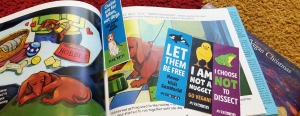
Free Stickers! Free Stickers!

 home > save animals > animal testing / dissection > cut out dissection

Cut Out Dissection
Mouse

More and more students from elementary schools to veterinary and medical schools are taking a stand against dissection before it happens in their classes. Every year, millions of animals—frogs, cats, mice, dogs, and others—are killed and shipped off to schools, where young people are given scalpels and told to slice up the animals' bodies as part of biology, anatomy, and other courses. YUCK!

It's disgusting, and it's wrong. But fighting against it is easy—and you have the right. Thousands of students have done it, and so can you. You might be the first person at your school to refuse—so do it! Express yourself and be a trendsetter, a trailblazer, and a hero for animals.

FAQ

How do I know if I already have a choice not to dissect?

If you're in grades K–12 and attend a public school in the following states, just say "No!": California, Florida, Illinois, Louisiana, Maine, Massachusetts, New Jersey, New Mexico, New York, Oregon, Pennsylvania, Rhode Island, Vermont, and Virginia.

These states as well as school districts in Austin, Texas, and Columbus, Ohio, have dissection-choice laws or policies in place. Private schools, colleges, and universities are not covered by those laws, but you can still get an alternative. You've just got to ask for it the right way.

For Canadian students, your right to refuse to dissect is protected under the Canadian Charter of Rights and Freedoms. South Shore, Nova Scotia, and Vancouver, British Columbia, are currently the only locations in Canada that have passed student-choice policies. School boards in Toronto as well as Kelowna and Westbank, British Columbia, are being encouraged to pass student-choice policies as well.

What if my class requires me to dissect?
  1. Find out as early as possible—preferably a few months before the course—what they say you have to do.
  2. Meet with the instructor right away and tell him or her that you can not participate in the dissection because of your "sincerely held religious and moral beliefs about the sanctity of all life," and ask for a non-animal alternative. These words provide the basis for a possible legal case. (You do not have to support any formal religion; the courts have interpreted a belief that animals should not be killed for classroom dissection to be a religious belief, which schools can not violate.)
  3. Offer to research the alternatives and find those that satisfy the objectives of the course. Show that you're willing to spend an equivalent amount of time and effort learning the lesson using a humane alternative. A number of organizations loan alternatives, including CD-ROMs and virtual dissections, to students and schools. The following organizations have extensive lending libraries and will be glad to help you find a suitable alternative and provide you with additional information and suggestions:

    National Anti-Vivisection Society (NAVS) 800-888-6287
    American Anti-Vivisection Society (AAVS) 800-729-2287
    Ethical Science Education Coalition (ESEC) 617-523-6020
    HSUS Alternatives in Education Database
    Physicians Committee for Responsible Medicine

  4. If you're still told, "Dissect or fail," proceed up the chain of command. Write to the principal, then the superintendent, and then the school board. Ask your parents or guardians to write on your behalf.
  5. Let other students and the community know how the school violates students' rights and hurts animals. Get everyone on your side! Form a group to demand students' right to a violence-free education. Write letters to the editor of the school and local newspapers. Circulate petitions among students, and gather signatures of support.

You can always call PETA for help with your dissection dilemma. We can send you literature and videos, psych you up, and use some PETA know-how and muscle to get your school to see things straight! Call 757-622-7382 to speak to a PETA rep today.

Do you have sample letters for me to use?

Letter to your instructor (adapt to fit your situation):


Date

Name of Instructor
Department Name
School Name
Address

Dear ______:

I am enrolled in [name of class]. I have just learned that all students are required to participate in the dissection of a frog. I will be unable to participate in the dissection because of my sincerely held religious and moral beliefs about the sanctity of all life.

Accordingly, I respectfully request that you provide me with an alternative that will not involve my direct or indirect participation in the dissection of any animal who has been killed for the purpose of a classroom dissection or at a slaughterhouse.

I would appreciate hearing from you at your earliest convenience.

Sincerely,

[Your signature]

Your name

Letter to the editor of your local paper (adapt for your situation):


Date

Letters to the Editor
Name of Newspaper
Address

Dear Editor:

Animal dissection, which was first used in classrooms in the early part of last century, is still being used in some [name of school] classes. In recent years, dissection has been increasingly scrutinized. Experts have reevaluated the educational worth and morality of cutting up animals to "see how they work."

Compassionate students want to study biology without dissecting animals. Sophisticated computer simulations, videodiscs, and models have been developed to meet the needs of these students. All the studies of this issue show that students who use alternatives perform as well or better than do students who use dissection.

Biology is the study of life and should teach respect for life, not devalue it by treating living beings as disposable objects. By using humane teaching methods, instructors can teach science and ethics simultaneously.

Sincerely,

[Your signature]

Your name
Daytime phone number


What should a student-choice policy include?

Sample Student-Choice Policy

  1. Alternatives to dissection must be available in all classes for students who choose not to dissect.
  2. The responsibility for creating an alternative lies with the teacher, not the student.
  3. Requiring the student to watch others dissect an animal is not an alternative; the student must be allowed to leave the room while the dissection is taking place.
  4. Students must not be penalized or ostracized in any way for choosing the alternative exercise.
  5. A student's choice to dissect or not to dissect shall be respected by all members of the school faculty, and the student shall be treated in a nonjudgmental manner. A student must feel free to choose an alternative to dissection without fear of being singled out or pressured.
  6. All students must be informed in writing of their option to choose not to dissect at the beginning of each semester during which dissection is scheduled, a minimum of three weeks prior to the dissection.
  7. Those instructors who still teach dissection in their classes must verbally announce the policy to all students on the first day of the semester and on the day of the dissection.
How to answer common arguments against alternatives to
          dissection

You're just being squeamish.
Feeling that dissection is wrong has nothing to do with being afraid or squeamish; for many students, it is a violation of deeply held principles. It is also O.K. to feel squeamish about doing something that you find morally offensive.

If we make an exception for you, other students will claim that they have the right to be excluded from all sorts of requirements.
This doesn't address the issue at hand: All students have a right not to be forced to violate their beliefs as part of their education. There's no quota on how many people are allowed to exercise their rights, and you can't take away rights just because a lot of people are exercising them.

Students aren't qualified to determine whether or not dissection is a necessary part of the curriculum.
Students are entitled to speak up when they're asked to do something that violates their ethics. If they are "qualified" enough to participate, then they are "qualified" enough to decide whether they object to participation.

Dissection wouldn't be taught if it weren't an important part of the curriculum.
Teaching techniques are constantly evolving and should be reevaluated regularly. Countless students are educated every year at top schools without dissecting animals.

There is no substitute for hands-on experience.
Actually, there are many substitutes for hands-on experience. But detailed models of animal anatomy and computer simulations both provide hands-on experience.

There are no suitable alternatives.
The Alternatives in Education Database from the Association of Veterinarians for Animal Rights as well as the Norwegian Inventory of Audiovisuals (NORINA) contain thousands of alternatives to animal use in education. (Most instructors who use this argument haven't considered any particular alternatives, so ask which specific alternatives the professor has considered and rejected and why.)

The student's claim to be a conscientious objector is inconsistent; he or she eats meat, wears leather, eats dairy products, etc.
Religious freedom means that you can subscribe to any set of views. Sadly, there are plenty of meat-eating Hindus, but they are Hindus nonetheless and can not be forced to do something else that they believe is forbidden by their religion. If a student believes that it is immoral to wear fur or dissect animals but O.K. to wear leather shoes, no one can dictate a different set of moral values to that student. Everyone has the right to draw the line where their conscience tells them to.

The school doesn't have enough money in its budget to purchase alternatives.
Many groups make alternatives available on loan to students who need them. And alternatives to dissection are more economical over time; many students can make use of one CD-ROM, for instance, but dissection requires that multiple animals be purchased time after time.

PETAKids e-news

Need More Facts?

You Can Help!

Iams Cruelty IAMS = Cruelty to
Animals

Dissection Alternatives Dissection
Alternatives

Answer Arguments How to Answer
Common Arguments
Against Alternatives
to Dissection

FAQ FAQ